



Here’s what most native speakers get wrong about IELTS: It’s not just a fluency test.
Speaking and understanding English well can give you an advantage, but it doesn’t guarantee you'll score well.
IELTS is a proficiency test with specific criteria and a defined format. You need to understand how your test is marked and what examiners are looking for to do well.
As with every test, you need to prepare.
Below, we’ll discuss the key strategies to help you get the best IELTS score as a native speaker.
How to get the best IELTS score for native speakers
Native English speakers achieve the best IELTS scores by preparing for the test format and marking criteria, not by relying on fluency alone.
Understanding task requirements, managing time, and demonstrating a clear range of vocabulary and grammar across all four skills (Listening, Reading, Writing, and Speaking) are all key to achieving a top score.
This guide covers: IELTS marking criteria
How to prepare for IELTS as a native speaker
IELTS Speaking: Test strategies for native speakers
IELTS Reading: Test strategies for native speakers
IELTS Writing: Test strategies for native speakers
IELTS Listening: Test strategies for native speakers
Common mistakes native speakers make in IELTS
Preparation materials for native speakers
Why do native English speakers need to take IELTS?
Many native English speakers are surprised when they are asked to take the IELTS test.
However, IELTS may also be required for native speakers for specific reasons:
University requirements for previous study
Some universities require IELTS if you completed high school or studied in a non-English-speaking country, even if English is your first language.
Academic English is different from everyday English
The IELTS Academic test measures how well you use English in academic and formal settings, including clear writing, logical organisation, and controlled grammar. Many native speakers do not use these skills regularly, which is why preparation still matters.
Not all native speakers use English the same way
Growing up in an English-speaking country does not always mean English is your main or strongest language. Some people speak a local language at home and use English less frequently in daily life.
Visa and migration rules may require formal proof
While some passports are exempt from English testing for Australian permanent residency, this does not apply to all visa types. Many native speakers are still required to provide official proof of English proficiency through taking a test such as the IELTS.
Understanding IELTS marking criteria
When taking the IELTS as a native speaker, you need to understand how your test is marked.
Your general fluency helps, but your answers should also have coherence, structure, tone, and accuracy. It’s best to review the band descriptors for each skill, but here’s a general overview of what’s expected from you on each part of the test.
Speaking
Fluency and coherence
Lexical resource
Grammatical range and accuracy
Pronunciation
Know more about IELTS Speaking band score descriptors
Writing
Task achievement (for Writing Task 1) or Task response (for Writing Task 2)
Coherence and cohesion
Lexical resource
Grammatical range and accuracy
Know more about IELTS Writing band score descriptors
Reading
Understanding of main ideas, details, and arguments.
Ability to locate information efficiently under time pressure.
Spelling accuracy in written answers.
Know more about IELTS Reading band score descriptors
Listening
Accurate comprehension of spoken information and detail.
Ability to follow complex ideas and reasoning.
Sustained focus across all four recordings.
Accurate transfer of answers, including correct spelling.
IELTS tips for native English speakers
Below are some tips to help you turn your strong language skills into the best possible IELTS score.
Understand the IELTS test format
IELTS offers two tests: IELTS Academic and IELTS General Training. Each is divided into four sections: Listening, Reading, Writing, and Speaking. Each section follows a fixed structure, timing, and task type.
When reviewing the test format, take note of:
How many parts does each test have
The question types
The time limit for each
What is expected in each task
Practise with official IELTS materials
Using official IELTS practice materials helps you get used to the real test. These materials are marked the same way as the real exam, so they give you a much clearer idea of how your performance will be assessed.
Develop test-taking strategies, not just language expertise
Doing well in IELTS is not just about speaking English well. It is also about knowing how to take the test.
A strong exam technique helps you:
Manage your time across each section.
Organise your answers clearly, especially in Writing.
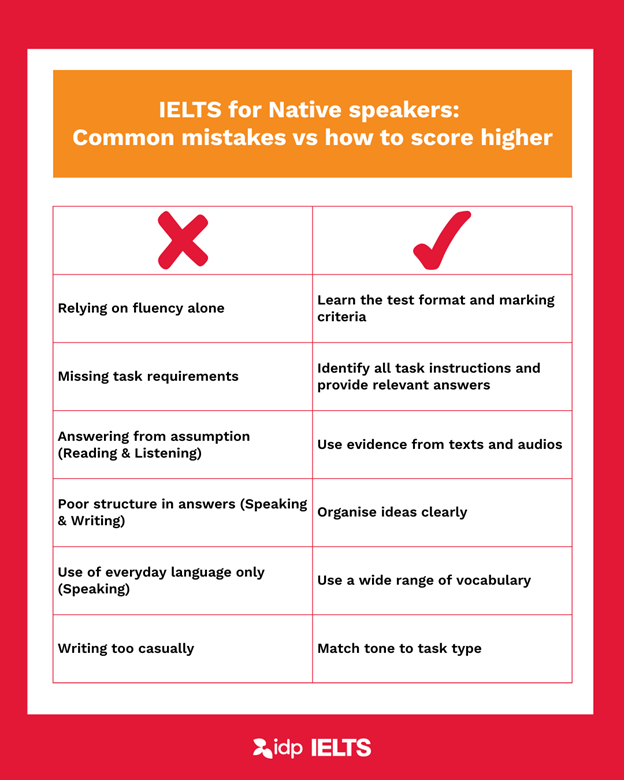
Avoid common mistakes, such as writing too much or giving very short Speaking answers.
Focus on accuracy and clarity, not just speed or confidence.
IELTS Speaking: Test strategies for native speakers
If you’re a native speaker, you probably already speak well in English.
But the difference between a Band 7 and a Band 8 or 9 is not just fluency.
It is how clearly, consistently, and intentionally you meet the marking criteria.
Here are some tips to help you boost your IELTS Speaking score:
Remember that there are no right or wrong answers
You’re not being judged on your opinions or experiences. You are being assessed on how you express yourself in English.
If you don’t connect with a topic, explain that and talk about something related. As long as you answer the question clearly, your response is valid.
Speak with structure, not just fluency
This directly affects fluency and coherence.
As a native speaker, it is easy to speak quickly, jump between points, or stop early because the meaning feels obvious to you.
To do better, slow your thinking slightly and guide the examiner through your ideas:
Add one clear reason or example to extend answers.
Use simple linking phrases to show progression.
Pause briefly to organise your thoughts before continuing.
Use a wide range of vocabulary, not everyday language
This addresses lexical resource, which measures how accurately and flexibly you use vocabulary.
Native speakers often rely on casual, everyday language or may repeat the same words across answers, which can limit the score at higher bands.
To improve:
Choose neutral or slightly formal words where possible
Paraphrase ideas instead of repeating the same phrasing
Use idiomatic language only if it feels natural and clear
Show grammatical control, not just natural speech
This targets grammatical range and accuracy. Native speakers usually communicate effectively, but informal speech habits, short sentences, or tense slips can reduce accuracy at higher bands.
To improve:
Mix simple and complex sentence structures
Be more aware of tense use when explaining past or future ideas
Self-correct naturally if you notice a small error
Aim for clarity, not a “perfect” accent
This relates to pronunciation, which is about how easy you are to understand, not which accent you have. Native speakers sometimes speak too fast, blend words, or drop endings, assuming meaning will still be clear.
To improve:
Slow down slightly, especially on keywords
Use natural stress and intonation to highlight meaning
Make sure word endings and sounds are clear
Speak at length to show your language skills
Speaking at length allows you to show:
How well your ideas flow
Your range of vocabulary
Your sentence variety
How accurate and natural your grammar sound
IELTS Reading: Test strategies for native speakers
Most native speakers can understand the Reading texts easily. The challenge at higher band scores is not comprehension, but accuracy, speed, and consistency under time pressure.
Base every answer on clear evidence in the text
This affects your raw score, which directly determines your Reading band.
Native speakers often skim too quickly and answer based on what seems right, rather than what the text actually says.
To do better:
Base every answer on clear evidence in the text.
Avoid answering from memory or assumption.
Double-check wording, especially qualifiers like: only, mainly, or some.
Master question types, not just the text
This directly impacts your number of correct answers.
Native speakers often lose marks on specific question types, not because they misunderstand English, but because they misread what the question requires.
To improve accuracy:
Learn how True, False, Not Given questions work
Understand what each question type is testing
Follow instructions exactly, including word limits
Follow the answer format exactly as instructed
If your answer does not match the required format, it will be marked as incorrect. This is something that confuses many test takers, and if you don’t prepare well as a native speaker, it can be a pitfall for you, too.
Here’s an example:
Instruction: Write NO MORE THAN ONE WORD AND/OR A NUMBER
You may write:
one word
one number
one word + one number
Examples:
Temperature - Acceptable because it is only one word.
18 - Acceptable because it is only one number.
Chapter 3 - Acceptable because it is one word and one number only.
Watch spelling accuracy
This directly affects your raw score. Even if their understanding is correct, native speakers often lose marks on small details like misspelling their answers, even just by one letter.
To avoid unnecessary losses:
Check spelling carefully, especially in short answers.
Follow exact answer formats.
Make sure answers are clearly transferred.
IELTS Listening: Test strategies for native speakers
The challenge in IELTS Listening is not just language ability, but accuracy, focus, and following instructions under time pressure.
Listen for detail, not just general meaning
This directly affects your raw score, which determines your Listening band. Native speakers often understand the main idea and move on too quickly, missing small but important details.
To do better:
Listen for exact words, numbers, and specific information.
Pay attention to qualifiers like only, first, before, or at least.
Avoid answering based on what sounds logical rather than what is said.
Read the questions before the audio starts
This supports accuracy and focus. If you do not know what you are listening for, it is easy to miss answers, even if you understand the conversation.
Follow the answer format exactly
This affects your raw score, even when your understanding is correct. Native speakers often lose marks by adding extra words or writing answers that feel natural rather than precise.
To avoid errors:
Follow word limits exactly.
Write only what is required, nothing more.
Use the same word form you hear in the recording.